Happy Free Year!!

Happy FREE Year!

As a special gift to my readers this holiday season, THE RED FANG – book 1 of the Before the Sun Rises Series, is FREE on Amazon now through the end of the year. Go grab your copy and find out why readers are calling this action-packed romance “not your typical paranormal story.”

Honest reviews are always welcome and greatly appreciated!!

Blurring the Lines – Serial Shorts, Serial Novels, and Book Series Explained

As a reader, I love reading book series. There is nothing quite like getting engrossed in a group of characters and following them through adventure after adventure over the course of a multi-novel series. I often discover my mind wandering after reading a book, wondering what was going to happen next, what had happened in Character X’s life to make him/her act the way he/she did. There might be tiny tidbits of information throughout the series that alluded to an even greater mystery, information that I would roll over and over in my mind, trying to decipher the meaning of it all. I would become greatly invested in the characters, their lives, their adventures, eagerly devouring novel after novel, falling ever more in love with the characters and their world.

With the steady influx of self-published authors over the past few years, I am finding that the lines of serial novels, serial shorts, and book series are becoming greatly blurred. Not only that, but I am quickly discovering that a lot of authors do not understand the difference between the three, resulting in mislabeling of their works and subsequently upsetting many of their readers.

In today’s article, we discuss the difference between a book series, serial novels, and serial shorts.

First, let us discuss the book series. A book series is generally a series of books written about or around the same group of characters. Each book contains its own story with a beginning, end, and resolution of some smaller, immediate problem in the story. The books may or may not have to be read in a certain order for the reader to be able to follow along.

Some examples of book series is Anne Rice’s The Vampire Chronicles or the Harry Potter series. While Harry Potter was an on-going saga that really required the reader to read the books in order to get the full picture of the main characters’ lives and how they grew and matured, each book was a complete story in itself. The Vampire Chronicles did not necessarily have to be read in order but was a series around several of the same characters. Many of the characters’ stories entwined throughout the series and oftentimes gave rise to a new novel that told about a previously minor character’s life or other adventure. What they all had in common is that each book was a complete story with beginning, middle, end, and most importantly, a resolution to the immediate problem. Additional examples would be the Sookie Stackhouse series by Charlaine Harris, the Anita Blake series by Laurell K. Hamilton, and the Twilight series by Stephanie Meyer.

Where a lot of people get confused is that a book series can also encompass a much larger problem/adventure. While each book contains its own story, the books together could tell of a larger story.  Many readers are getting the idea that such a series is actually a group of serial novels, and a lot of the confusion is being created by authors who do not know the difference between the two, or who are mislabeling their works. Take for instance my own Before the Sun Rises series. Each book contains its own story with beginning, middle, end, and resolution to the immediate problem presented in each book. However, because the books hint at a much larger problem that is not immediately rectified in any one book, some readers wrongfully consider them serial novels.

So exactly what are serial novels and serial shorts?

First, I will discuss the serial short. Think of these as TV series, or comic books. They are generally based around the same group of characters in an on-going adventure. Serials are not necessarily meant to have a conclusion and are generally written until the demand for the characters and their decline.  Serial shorts, like their name imply, are generally about the length of a short story, usually under 15K words or less.

Since the serial is not really meant to ever have an ending, the storyline may seem to ‘wander’ or not have any sense of direction. There may not seem to be a ‘larger problem’ hinted at that needs to be resolved, or, if there is, once the problem is solved, a new one just crops up, much like you see on season finales of TV series when the ‘larger problem’ that the entire season was escalating towards just leads to another problem.

With serials, many times the next installment in the serial will pick up right where the last one left off, or it will switch up between several groups of characters with each new installment in the serial depicting an adventure for one specific group of characters. The entire serial could be written so that each installment bounces from one group of characters to another, oftentimes entwining their stories.

The main difference you will notice as a reader is that each installment is incomplete; there is not a beginning, middle, end, or resolution to a problem. The installments will have to be read in order from beginning to end in order for the reader to get the full adventure.

Finally there is the serial novel which oftentimes gets confused with a series. As discussed previously, books in a series will be a complete story in itself with a beginning, middle, end, and resolution to a problem identified in the book but the series as a whole may present an even larger problem. The main theme is that each book will contain its own story with a conclusion. A serial novel, however, can get a bit tricky.

First, there is the serial novel that is much like the serial shorts, the only difference being the length of each installment. The installments might be the same approximate length of a full novel or novella, usually 20K words or more. Like their shorter counterparts, the serial novel can be an on-going saga that the author never really planned to end, rather, was just writing until demand for the characters and storylines naturally declined.

However, the most common type of serial novel is a novel that, when finished, represents a complete story in itself. Basically it is just a full length novel that has been broken up into installments but, when combined, represent one complete storyline with a beginning, middle, end, and resolution to the problem presented in the story.  For example, the third book in myBefore the Sun Rises series, Clan of the Claw, is being released in installment, or episode form. Once finished, the installments will represent one whole, complete book with beginning, middle, conclusion, and resolution of a problem that arose during the telling of the story.

So as a reader, you may wonder why authors would purposely decide to write serial shorts or novels. Many readers feel cheated when they get to the last page and realize that there is no conclusion, no resolution to the problem presented in the storyline, and with good reason. Many readers think that an author’s primary reason for doing this is to earn more royalties since having more items for sale could translate into higher earnings. While this may be true, and I will have to leave the discussion of math and royalties for another article, there are other reasons for authors to decide to release serial shorts or serial novels.

For myself, I decided to release book 3 in the Before the Sun Rises series in episode form not because it would garner me more royalties (the number of installments I have planned and their price point will equal out exactly the same for readers whether they decide to read the installments as they come out or if they decide to wait and purchase the entire book), but because I did not want my readers to have to wait for months, possibly even a year or longer, before they would have access to the next book. As I work a full time job outside the home in addition to writing, it takes me a bit longer to produce a final product than it does for those writers who have the luxury of writing full time. Because of this and the sheer number of new books being released each and every day, I knew that forcing my readers to wait a year or longer could very well be career suicide. From a business stand point, I knew that I needed new material coming out every few months but as a working writer holding other jobs, it just is not feasible for me to produce a new novel every few months. For myself and other authors like me, deciding to write a novel in installments and making those installments available to the public as they are written means my name stays out there in the mix, allowing me to continue to bring in more readers.

While it is true that some authors may decide to write an entire novel and then break it up into installments and sell them individually to garner themselves a larger royalty check, there are additional reasons that authors may decide to release serial shorts or novels. Some authors may only have a vague idea of what the ‘bigger picture’ is when they started writing, and instead of trying to force it into a novel with an end, they choose instead to post it  as a serial short and just let the story and characters go wherever they may.

I feel that serial shorts are no different than a TV series. It’s understandable that some readers may get miffed to learn that the $4.99 they just spent turns out to be a mere 10K words in an ongoing saga, and rightly so, but other readers may not mind paying $.99 for an ongoing  adventure with characters that they have an emotional investment in. Again, it’s no different than getting caught up in a TV series such as The Walking Dead or Supernatural. While I may not be directly buying the TV series from its source, you can bet I will pay whatever premium package price is asked by my satellite provider to keep my AMC channel. Who I pay makes no difference; the simple fact remains that I am willing to pay to keep watching because I am emotionally invested in the characters and storylines.

Still other authors simply prefer to read on-going serials such as comic books etc. and will naturally gravitate to write in this form as well. As with everything else dealing with the literary world, it truly is a personal choice. As readers, while we may not like the idea of wasting endless amounts of money on an on-going saga, we can also cheat ourselves out of some wonderful adventures and characters by not giving these serial novels and shorts a chance. As one reader said, “If I fall in love with the character and story, I’m going to read it no matter HOW it is released.” This simple statement holds true for most readers.

However, as authors, we do need to keep in mind that in today’s economy, and especially with so many authors giving away the milk for free so to speak, our readers are being forced to be more economically conscientious than ever before.  Our best bet is to continue to provide the highest quality product we can at a fair price. After all, at the end of the day, whether you are a reader or an author, a good story truly is in the mind’s eye of the reader.

Editor Versus Proofreader: Which is Right for an Author?

In this vast, new world of the indie publishing, authors are now finding themselves wearing many new hats. No longer are we just the wielder of the pen creating worlds and characters out of words and imagination, we are now finding ourselves also becoming graphic artists, editors, formatters, promoters, and marketing gurus. Many times, however, we either do not have the time or the expertise to fill all these roles, opting instead to hire someone who can polish our work to perfection with just the right flare.

Naturally, this influx of indie authors into the literary and publishing world means more and more people are opening up their own side businesses to try to fill the need the self-publishing boom has created. Freelancers are now offering their expertise as graphic cover artists, formatters, editors, and proofreaders to those authors who are in need of their services.

But what if, as an author, you don’t really know what you need? Unfortunately, in the self-publishing business, not knowing can mean the difference between getting a quality, finished service, and getting parted from your hard-earned money without the polished product you were expecting. In this article, we explore the difference between an editor and a proofreader.

Proofreader:

In short, a proofreader goes through your manuscript with a fine-tooth comb and corrects any and all typographical, punctuation, and grammatical errors. Think of them as spell checks with fingers. They go beyond what a normal spell-checker program can pick up to ensure capitalization and punctuation are used correctly, correct word  usage (‘two’ versus ‘to’, ‘too’, etc.), subject/verb agreement, and ensures there are no shifting tenses. When a proofreader is done, your manuscript should be free of any typographical, punctuation, and grammatical errors. A proofreader does not necessarily point out inconsistencies in your storyline or plot holes, but are really just there to find the obvious grammatical and punctuation errors.

Proofreaders generally charge by the word, and they can range greatly between freelancers, companies, and individuals with their own sole proprietorship. I’ve seen everything from $0.005 to $0.008 per word with some going as high as $0.14 per word or about $35/hour. It can get expensive very quickly, and this is not for anything other than basic grammar and spell check.

Editor:

Now let’s discuss editing. This is where I’m seeing a LOT of misuse of the word in the freelance and indie author community. A lot of authors are using the term ‘editor’ and ‘proofreader’ interchangeably, and are hiring freelancers who are calling themselves editors and charging editor pricing, but are actually just delivering proofreader performance.

Some will argue authors actually need to hire both a proofreader AND an editor because they offer separate services. Others will state while an editor can do everything a proofreader can do, a proofreader is not an editor. I tend to agree with the latter. As an author, you need someone who can not only polish out the typographical and grammatical errors, but also someone who can help fine-tune your writing style and syntax to ensure your story is the absolute best it can be. Most editors, however, will not help with proofreading-type duties and will stick to just helping with sentence structure and an overall development of writing style.

So exactly what does an editor do? An editor goes one step beyond proofreading to help a writer ‘find their style.’ They help with the overall flow of the language and often will rewrite portions of the manuscript so the style stays consistent throughout. They help clear up ambiguity and syntax problems. In essence, it takes more than just a strong background in English and goes beyond finding mere typographical errors. An editor also has a measure of intuition and knows what looks and sounds right on the page. A professional editor will not only clean up the grammatical and punctuation errors, but will also use his/her knowledge of English grammar and the literary world to ensure your manuscript sounds its absolute best.

Editing can further be broken out into line edits (or a general editor, as some refer to them) and copy editing. While these types of edits share a lot of similarities, there are also a lot of differences and are handled in different ways, and once again require different skill sets.

LINE EDITS: Line edits address the writing style, the creative content of the work, and the language/syntax used at the sentence, or line-by-line, level. However, the goal is not to look for errors (again, that is technically what a proofreader does) but to help a writer develop his/her writing style, to help with sentence structure, and to ensure the writing flows smoothly. A line editor may call attention to run-on sentences, overused words and sentences, can pin-point words or phrases that are being overused or not needed (for example, I had an editor point out I used the filler word “that” entirely too much in my writing). They help find redundancies in description, help tightened up scenes (show, not tell), and can help with dialogue. In essence, an editor is not just finding mistakes in any given manuscript, but is going to help point out all the things which can be improved in your future manuscripts to help you become a better writer and a better storyteller.

COPY EDITING: A copy editor is more like a very high-end proofreader. They help read out typographical, spelling, punctuation, and grammatical errors.They also work much like a formatter to ensure font styles and formatting structure. In addition, they help weed out inconsistencies in the storyline, such as a character whose physical traits were mistakenly changed in the manuscript, plot holes, etc.

It is the job of the copy editor to fix your typos, your inconsistencies in your storyline, and your punctuation. It is for this reason that a copy edit should always come after a line edit, once the storyline has been completely finished and is ready for a fine-tuning.

This is where I feel both freelancers and unknowing authors fall into a trap. Authors need someone who can do both, or if they cannot find someone who can do both, they need to learn the difference. If given a choice, an author really needs to hire a line editor and copy editor and skip a proofreader altogether if budget permits. If not, then a line editor followed by a really good proofreader is in order. In the trade publishing industry, publishers hire editors who can not only clean up your typos, but they will also help you develop your writing style. In the land of the indie author, many freelancers are claiming to be ‘editors’ but are actually only offering proofreading services, and some of them are not up to par on the proofreading services either.

As an author, it is your responsibility to not only know the difference, but to be sure you are hiring someone who not only also knows the difference, but who is providing you with the service you are requesting. In the end, you only get one chance to make a good first impression on your reader. As the author, that responsibility ultimately falls on your shoulders. Not ensuring your work is polished to perfection can mean the difference between being a one-book author, and having real staying power with a reputation among your readers as an author who consistently provides the absolutely best quality work possible.

Why Traditional Publishing is Still Not an Option for Most Writers

One of the questions I get asked the most by other, “serious” writers, is “Why aren’t you trying to get a traditional publishing deal?”

First off, I, like most other writers, don’t have the option or luxury of writing full time. We have bills to pay, families to feed, and all those pesky little necessities that insist upon being paid every month, like electricity and the mortgage. So for a huge chunk of us, with me being right there in amongst them, we have to have a full-time Evil Day Job that helps pay those bills and support our families. It’s a simple fact of life. Trust me, if I could afford to write full time and not have to work, I would quit this gawd-awful hell I go to each day and plop my happy arse down in front of my PC for 12 hours a day and pound out a few books a year. Unfortunately, I live in the real world, so I have to have my job to help pay the bills. It’s not a matter of choice; it’s a matter of my kids needing to have food in their bellies and a roof over their heads.

So I guess the next question for most everyone would be, “So what does that have to do with getting a traditional publishing deal?”

In the past few months I have seen numerous authors in my FB feed overjoyed that they finally got a traditional publishing contract, some of them from really big name companies. I’m happy for them, really, and I’ll admit, I’m absolutely pea-green with envy. But my first question to them, after congratulations, is “Did you get an advancement?”

I already knew their response even before they answered me, because I have already been down this road so many times over the past twenty-five years. The vast majority of them have responded to state that the companies, even the large ones, did not offer them any type of advancement, just a book deal that covered X number of books to be published over X number of years. Some were lucky and got offered a few thousand dollars, but most were not offered any type of advancement.

My next question to them was, “Okay, so what about marketing and promotions? How much are they going to spend towards marketing your books?”

Again, I knew the answer and was not shocked when they told me that they companies hadn’t really mentioned anything about it, or they hadn’t confirmed any hard marketing plans yet. What I was shocked to hear was how many of them never once broached the subject of promotional ventures and budgets with these companies. Those few who did think to ask or had the information provided to them in the contract all reported the same thing: the marketing of the book would be left up to the author until such a time as the publishing company had recouped the money spent on editors, printing, and graphic artwork.

As I said before, I have to work to pay the bills, so signing a contract with a company, even if it were Random House, would not be feasible for me if it did not come with a large enough advancement to replacement my current income. Now that I have said that, let me clarify this by saying I could not sign a contract with a regular publishing company UNLESS they either offered a large enough advancement to replacement by current income OR they were willing to spend money to market and promote my books, i.e. get them in major bookstores across the country with prime shelf space, ads in major publications, get it in front of critics who could help launch my career, and possibly some talk shows or radio shows.

So you are probably wondering why on earth I would pass up signing a contract with a publishing house, even a big one, even if it meant I didn’t get an advancement or any type of marketing support? Wouldn’t the exposure of having a big name publishing company printing my book help launch my career? The answer to this, unfortunately, is not so cut-and-dry, and is both a ‘yes’ and ‘no’ question.

First off, most readers, and even authors, can’t tell you who publishes the majority of the books they read. Sure, you probably know who publishes your favorite author of all time, but 99% of people who read have no clue who actually published the book. Why? They don’t care. Readers don’t care if Random House published the book or if Joe Blow Press published it. All anyone cares about is whether or not it’s a good book, so having a ‘big name’ publisher means absolutely jack-shit to a reader.

Second, if no one cares who publishes the book, then how is having a big name publisher print my book going to help me? If they are not marketing my books, not getting them into book stores, not getting them in front of critics and major publications, then exactly WHAT are they doing for me? The answer to this is N-O-T-H-I-N-G.

If Random House offered me a deal today but refused to pony-up any type of marketing dollars, it would not help me one damn bit so far as readers are concerned. Sure, authors would be jealous as hell, but readers honestly don’t give a rat’s ass. The readers I already have would be overjoyed for me, but those who didn’t want to read my work in the first place are not about to go rushing to bookstores to snatch it off the shelves just because I announced that Random suddenly wanted to publish me. Trust me on this, it isn’t going to happen. How many times have you used the “Look Inside” feature on Amazon, or read a teaser on FaceBook, and groaned over the storyline and writing style? What happened? You rolled your eyes and didn’t bother to purchase. Now imagine if that same author announced that Random House had picked up their latest series. Are you suddenly going to rush out JUST because Random House decided they could make a quick buck off it? Um, NO, so it’s not like having their name on the inside of your book is going to make people hunt you down UNLESS they are marketing the shit out of your books.

I’ve seen dozens of authors signing these deals with big name publishers and a year later I still have not seen their books on the shelves of book stores, they have not become a house-hold name, they are not being offered movie deals and they are still having to do their own marketing and promotion through FaceBook and begging bloggers to review their work. They have to pay for those ARCs out of their own pocket because, when a publisher publishes on Amazon for you, you no longer have an ecopy that you can send. Instead, you have to purchase them through Amazon and gift them to readers and bloggers, costing you the precious little bit of royalties you have earned.

So now the big question is, if being picked up by a big publisher isn’t going to help an author in any way, then why on earth would they do it? The amount of royalties they get are far less than they are when self-publishing through Amazon. They are still going to have to do their own promotion and marketing and pay for all that out of their own pocket. Readers don’t really care who publishes them so using that name as a marketing tool is not going to garner them a whole lot of extra readers. So why do it?

For some writers, just getting that contract is enough. And to be honest, even if I did not get offered an advancement or any type of marketing plan behind the deal, I would still sign just to say that I was “good enough” for someone to take notice. However, this simply is not enough for most authors. And while I might be willing to sign a contract for one book, I can’t see myself signing a major contract for numerous books UNLESS it came with a large enough advancement to take the place of my current income. Because let’s face it, I’m already doing my own marketing, my own promotion, lining up my own blog tours and paying for my own editing and graphic work PLUS I get to keep 70% of my royalties. A better question for authors is, “If you are already doing all that, why would you sign a contract with a publisher who is going to make you continue to do all that AND take half your royalties away from you?”

Why indeed.

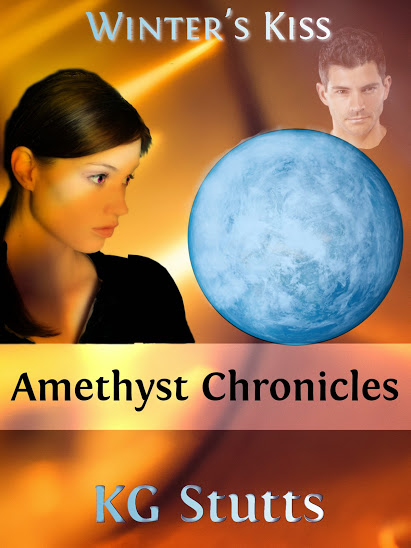
Winter’s Kiss by K.G. Stutts – The Amethyst Chronicles – COVER REVEAL

AmethystC1b

On November 21st, book one in a highly anticipated sci-fi novella series, Amethyst Chronicles: Winter’s Kiss launches from brought to you by KG Stutts, the author of the Mirror series. This is actually a spin-off, taking place over a thousand years after the third in Mirror trilogy, Mirror Reformed (out January 16th).

Blurb:

Amethyst is a secret team of genetically enhanced humans which is Earth’s greatest defensive weapon. Leading the team of super soldiers is Ember Wilson, a tough woman with a huge chip on her shoulder. The team gets their name from the after effect of the Genesis Project which turned their eyes and even their blood purple.

For decades, Earth has been ravaged by unpredictable weather which began to cause crops to fail. Most of the planet’s food sources have deteriorated. Dr. Clayton Rudo has proclaimed he has the means to save the soil. He has created a weather machine to regulate and help replenish. But Ember knew the truth. He didn’t want to save the planet. He wanted to control it. Amethyst destroyed the machine, but was placed in stasis. Two years later, Rudo recreated the device and has frozen Washington, DC and the west coast of the United States.

General Tom Blanchard brought Amethyst out of stasis to work with an elite Air Force team, led by Major Liam Ross. Tensions between Ember and Liam rise as they butt heads. Can they work together before Earth is completely under ice?

Excerpt:

A lab technician carefully brought Ember Wilson out of stasis. Liam stood back as her team surrounded the final pod. Her violet eyes fluttered open and Liam’s hands began to shake. He couldn’t believe how stunning she was.

“What the hell?” she groaned.

“You’ll feel sick to your stomach for a moment, but it will pass,” Lewis informed her.

“My head,” she muttered, rubbing her temple. “What did that empty-headed, bureaucrat ass kisser Blanchard to do to me? How long have we been out?”

“Two years,” he replied.

“Wilson, take a second to get your bearings,” Morris said.

“You’ll feel back to normal in a moment,” Nova added.

She scanned the lab, coming to a stop the moment her eyes locked on the General. Her foot pressed against the back of the pod, her eyes wild with anger.

“You son of a bitch!” she yelled as she used her foot to launch herself in the air.

Nova and Morris caught her before she could reach Blanchard. She kicked and screamed for freedom but the duo wouldn’t budge. She jerked against the hold they had on her arms, spitting and cursing.

“I know,” Lewis calmly said as he stood in front of her. Her foot was inches from his chin when she kicked. “Hey, it’s okay. I know. But there are more pressing matters at hand than him.”

“Rudo?” she asked through gritted teeth.

“You got it.”

“You moron!” she shouted, looking over Lewis’ shoulder to Blanchard. “You had the chance to stop it before he could act but you were too much of a coward!”

“I’m sorry–”

“Sorry? Sorry?” Her voice was nearly shrieking. “Not yet, but you will be.”

“Wilson, Rudo used the weather machine,” Nova stated, his face contorted as he strained to keep his hold on her.

“Of course he did! And now we’ve got to clean up the mess.”

“Whatever problems you and I have aren’t important right now,” Blanchard said.

“You got that right,” she snapped. “I’m going to finish what I started and kill Rudo and maybe you’ll be lucky not to meet my blaster.”

“There’s no cause for that,” Liam spoke up.

Her purple eyes looked upon the Major for the first time. He instantly regretted interrupting. She stopped struggling against Nova and Morris. A low growl rumbled from deep in her throat as her eyes narrowed. He shifted uncomfortably, fidgeting with the hem of his dress blues. The coldness in her eyes made him shiver.

“Who’s the uniform?” She nodded in his direction.

“This is Major Liam Ross,” Blanchard introduced. “His team will be working with yours on this mission.”

“Absolutely not.” Ember shook her head as Nova and Morris let go of her arms. “We’re all you need.”

“President Packer disagrees.”

“I don’t give a flying monkey’s butt what Packer says.”

“This is bigger than your raid on Rudo. You need the man power.”

“No one else could’ve broken into the compound! We don’t need or want the help.”

“It doesn’t matter.”

“Doesn’t matter.” Ember fumed. “In case you’ve forgotten, we don’t work well with others.”

“I know. The leader of the Luteus team still isn’t one hundred percent after the skirmish your two teams had.”

“It was a training exercise. Besides, if Mark is still healing after all this time, he should spend time in a therapy tank. That’s not my problem.”

“Regardless of how you feel, this is the situation. Or you can be put back into the stasis chamber.”

“Not on your life.” Ember’s lips twitched.

“Glad we’ve reached an accord.” Blanchard nodded.

Wilson turned to Ross again, sizing him up. He was tall and, judging by the way his Air Force blues molded to him, was very muscular. His brown hair framed his handsome face but didn’t touch the collar of his impeccably clean uniform. Soft brown eyes were watching her intensely.

“Can your pretty boy even hold a blaster?” She questioned Blanchard, nodding toward Liam.

“Direct your inquiries toward me.” Liam stood up straighter.

Ember raised an eyebrow, looking slightly amused. “Oh, yeah?”

“I’ll have you know that I’m the number one ranking sharpshooter in the world,” he told her.

“It’s cute you think like that. Rankings don’t mean shit,” she said. “Scores on a piece of paper are useless in the field.”

“I assure you, Major Ross and his five squad members are more than capable of the task,” the General said.

“Five?” The members of Amethyst began to laugh.

“You need a squad of five?” Ember chuckled. “Rookie.”

“You only need three on your team?” Liam incredulously asked.

“I only need two, but Nova grew on me.”

“Aw, thanks, Wilson.” Nova grinned. “That may be the nicest thing you’ve ever said to me.”

Ember’s eyes burned into the Major’s as she continued to assess him.

“All right, pretty boy. Let’s see what you and your boys can do,” she said. “Collect your squad and meet us in the training center.”

Look for Winter’s Kiss available for pre-order on October 30, 2014.

Visit KG Stutts on the web.

Join the launch party on FaceBook.

Like KG Stutts on FaceBook.