Parallels Between Anne Rice’s Queen of the Damned and Egyptian Deities

If you’ve ever went down the rabbit hole with vampirism and the different myths, such as those with Vlad the Impaler, Dracula, etc., you’ve probably no doubt a fan of Anne Rice’s The Vampire Chronicles. I’ve read nearly every book in the series, some of them multiple times, and I’ve always been fascinated with the characters of Akasha and Enkil and their origin story. I did some digging, and here are a few parallels and differences between Akasha and Enkil’s origin story and a few of the Egyptian myths an deities that could very well have been Anne’s muse for the storyline.

Anne Rice’s Queen of the Damned (1988), the third novel in The Vampire Chronicles, introduces Akasha, the first vampire and a pivotal figure whose origin story intertwines themes of blood, immortality, and divine power. To analyze and compare Akasha’s narrative with Egyptian deities or myths, we’ll focus on her role as the progenitor of vampirism, her godlike status, and the mythological underpinnings of her story, drawing parallels with Egyptian figures like Sekhmet, Isis, and Osiris, whose myths share thematic resonances.

Akasha’s Role and Origin in Queen of the Damned

In Rice’s novel, Akasha and her husband Enkil, ancient Egyptian rulers, become the first vampires around 4000 BCE when a malevolent spirit, Amel, fuses with Akasha’s blood after she is mortally wounded. This transformation renders her immortal, superhumanly powerful, and dependent on blood for sustenance. Akasha is revered as the “Queen of the Damned,” a near-divine figure who sustains all vampires through her existence. Her awakening in the modern era brings apocalyptic ambitions, as she seeks to reshape the world, viewing herself as a goddess-like arbiter of life and death. Key themes include:

  • Blood as life force: Vampirism is tied to blood consumption, symbolizing both vitality and destruction.
  • Immortality and divinity: Akasha’s transformation elevates her to a godlike status, yet she is cursed with isolation.
  • Creation and destruction: Akasha embodies a dual role as the mother of vampires and a potential destroyer of humanity.
  • Egyptian setting: The novel’s ancient Egyptian backdrop invites comparisons to the culture’s mythology.

Egyptian Deities and Myths: Comparative Analysis

Egyptian mythology, rich with gods and narratives about creation, destruction, and immortality, offers several figures and stories that parallel Akasha’s mythos. Below, we explore Sekhmet, Isis, and Osiris, focusing on thematic and narrative similarities.

1. Sekhmet: The Bloodthirsty Goddess of War and Healing

Sekhmet, the lioness-headed goddess, is a prime candidate for comparison due to her association with blood, destruction, and divine power.

  • Mythological Context: Sekhmet was created by Ra to punish humanity for rebellion. She became a relentless force of destruction, slaughtering humans and drinking their blood until Ra tricked her into consuming beer dyed red to resemble blood, intoxicating her and halting her rampage. Sekhmet also has a dual role as a healer, capable of curing plagues and restoring balance.
  • Parallels with Akasha:
    • Blood and Destruction: Like Sekhmet, Akasha is defined by bloodlust. Her vampiric nature requires blood to survive, and her awakening in Queen of the Damned unleashes a destructive vision to eradicate most men and establish a matriarchal utopia. Both figures embody primal, uncontrollable power tied to blood.
    • Divine Femininity: Sekhmet’s status as a goddess mirrors Akasha’s self-perception as a divine queen. Both are revered and feared, wielding authority over life and death.
    • Duality: Sekhmet’s dual role as destroyer and healer resonates with Akasha’s position as the creator of vampirism (giving “life” to vampires) and a potential annihilator of humanity. However, while Sekhmet’s destruction is tempered by divine intervention, Akasha’s is driven by her own agency, reflecting a modern reinterpretation of divine will.
  • Differences:
    • Sekhmet’s bloodlust is external, a divine punishment, whereas Akasha’s is intrinsic to her vampiric nature.
    • Sekhmet operates within a divine hierarchy under Ra, while Akasha is a singular, autonomous figure, unbound by higher gods.

2. Isis: The Mother Goddess and Magical Transformer

Isis, the goddess of magic, motherhood, and resurrection, offers another lens for comparison, particularly in Akasha’s role as a progenitor and her transformative power.

  • Mythological Context: Isis is best known for resurrecting her husband Osiris after his murder by Set, using her magical prowess to reassemble his body and conceive their son, Horus. She is a symbol of maternal protection, magical transformation, and the restoration of life, often associated with the life-giving Nile.
  • Parallels with Akasha:
    • Creation and Motherhood: Isis’s role as a mother figure, giving life to Horus and symbolically to Egypt through her magic, parallels Akasha as the “mother” of all vampires. Akasha’s blood, infused with Amel’s spirit, creates the vampiric race, much as Isis’s magic enables continuity through Horus.
    • Transformation: Both figures are linked to transformative acts. Isis transforms Osiris into an immortal god of the underworld, while Akasha’s transformation into a vampire grants her and others eternal life, albeit with a cursed twist.
    • Power and Agency: Isis’s use of magic to defy death reflects Akasha’s godlike powers, including telepathy, telekinesis, and invulnerability, which she uses to assert her will.
  • Differences:
    • Isis’s actions are benevolent, aimed at restoration and protection, while Akasha’s are often destructive, driven by a nihilistic vision.
    • Isis operates within a mythological framework of balance (ma’at), whereas Akasha’s vampirism disrupts natural order, aligning more with chaos.

3. Osiris: The God of Death and Resurrection

Osiris, the god of the underworld and resurrection, shares thematic links with Akasha’s immortality and the cost of eternal life.

  • Mythological Context: Osiris, murdered and dismembered by Set, is resurrected by Isis but becomes lord of the underworld, embodying the cycle of death and rebirth. His myth emphasizes sacrifice, transformation, and the price of immortality, as he can no longer dwell among the living.
  • Parallels with Akasha:
    • Immortality’s Price: Osiris’s resurrection comes at the cost of his earthly life, confining him to the underworld. Similarly, Akasha’s vampiric immortality isolates her, requiring blood and severing her from humanity. Both figures pay a steep price for eternal existence.
    • Sacrificial Transformation: Osiris’s death and rebirth mirror Akasha’s near-death and transformation by Amel’s spirit. Both involve a bodily violation (dismemberment for Osiris, spiritual possession for Akasha) that leads to a new, divine state.
    • Legacy: Osiris’s legacy continues through Horus, while Akasha’s lives on through the vampiric bloodline, linking both to generational continuity.
  • Differences:
    • Osiris’s resurrection is passive, dependent on Isis, while Akasha’s transformation is a direct result of her encounter with Amel, giving her greater agency.
    • Osiris represents cyclical renewal, tied to agriculture and the Nile, whereas Akasha’s immortality is static, a frozen state of predation.

Broader Egyptian Mythological Themes

Beyond specific deities, Akasha’s story resonates with broader Egyptian mythological concepts:

  • Blood and Life Force: In Egyptian mythology, blood (especially divine blood) is often linked to life and power, as seen in myths where gods’ bodily fluids create life or sustain the cosmos. Akasha’s blood as the source of vampirism aligns with this, though Rice subverts it into a darker, parasitic force.
  • Divine Kingship: Egyptian pharaohs were seen as living gods, a concept reflected in Akasha’s royal status and her claim to divine authority. Her ambition to rule as a goddess-queen echoes the pharaoh’s role as a mediator between gods and humans.
  • Chaos vs. Order (Ma’at vs. Isfet): Egyptian mythology emphasizes ma’at (order, balance) against isfet (chaos). Akasha’s apocalyptic vision disrupts ma’at, positioning her closer to chaotic forces like Set or Apophis, despite her claim to divine order.

Comparative Synthesis

Akasha’s narrative in Queen of the Damned blends elements of Sekhmet’s bloodthirsty destruction, Isis’s maternal and transformative power, and Osiris’s sacrificial immortality, but reinterprets them through a modern, gothic lens. Unlike Egyptian deities, who operate within a cosmic balance, Akasha is a solitary figure, unbound by divine hierarchy, reflecting Rice’s existential exploration of power and isolation. Her vampirism subverts the Egyptian ideal of eternal life (achieved through mummification and the afterlife) into a cursed, predatory existence, highlighting a tension between divinity and monstrosity.

  • Closest Parallel: Sekhmet is the most direct comparison due to the shared imagery of blood, destruction, and divine femininity. Akasha’s rampage in the novel mirrors Sekhmet’s near-annihilation of humanity, though Akasha’s motivations are personal and ideological, not divinely ordained.
  • Unique Elements: Rice’s use of a demonic spirit (Amel) as the source of vampirism has no direct Egyptian parallel, drawing more from Mesopotamian or Judeo-Christian demonology. This externalizes the origin of Akasha’s power, contrasting with the innate divinity of Egyptian gods.

Conclusion

Akasha’s story in Queen of the Damned draws heavily on Egyptian mythological themes of blood, immortality, and divine power, with strong parallels to Sekhmet’s destructive bloodlust, Isis’s transformative motherhood, and Osiris’s costly resurrection. However, Rice reimagines these elements in a darker, more individualistic framework, where Akasha’s godlike status is both a gift and a curse. By rooting her narrative in ancient Egypt, Rice taps into the culture’s fascination with eternal life and divine authority, but her vampiric lens transforms these into a meditation on power, isolation, and the human desire for transcendence. For further exploration, examining primary Egyptian texts like The Book of the Dead or myths from Plutarch’s De Iside et Osiride could deepen the comparison, though Rice’s fictional Egypt is more atmospheric than historically precise.

I
For Those Who Know Me IRL, a Social Media Update

For those who know me IRL, you may have noticed that my personal social profile on FB disappeared last week. This was not an accident, unfortunately. So sick back, buckle up, and let me explain why I’ve not had social media in my “real” name since 2010.

In 2010, as I was finishing up my last two semesters of college, it had become quite normal for employers to not only check out employees’ and potential employees’ social media accounts, they were also using the content as determining factors to hire and/or terminate. We all knew it was going on, and while no one approved of it, it was just another one of those things that we had to put up with. Since I wasn’t very active on any of my IRL accounts, I opted to delete everything that included my “IRL” persona, keeping only those accounts for my pseudonym.

Fast forward to last week, when I found out that my current EDJ made the very unethical decision to terminate someone after finding their TT account. Not because of outlandish claims or questionable morals or ethics. No. This determination was made after the person in question made a video flying the bird. Yeah. First amendment be damned, right?

Needless to say, I opted to once again delete any IRL social media accounts I had. I have also made the decision to not only cut back on any personal information that I share through my social media accounts, but I am also being more proactive to ensure that anything dealing with my IRL, personal life is only made available to specific friends and family on all of my accounts.

While I am loathe to do this, it is the only way I can protect myself from any potential backlash. I will say that in 2024, it is utterly ridiculous that I am still forced to choose between my constitutional right to free speech and self expression, the author brand I have spent over 20 years building up, and an EDJ that (half-ass) pays the bills.

To Blog or Not to Blog: an Ode to Keyboard Warriors

I’ll be honest. I kind of miss blogging. It’s my site, my page, my rules. Unlike social media, where as soon as you post something everyone seems to think it automatically gave them the greenlight to share their opinion about your opinion, insult the poster and everyone else they don’t agree with, and basically just shit on everyone. Blogging is much more, dare I say it – refined.

Okay, so maybe refined is too strong a word. But, if nothing else, blogging definitely gives the poster a lot more control over who gets a voice on their own personal page. Sure, you can always delete out a comment on social media, but there’s no way to monitor them. So by the time you come across the offending comment six plus hours later, the damage has been done. You’ve lost face. The commenter, and everyone else who has come across the post and comment, believe you have tucked your tail between your legs and admitted defeat. Not so when it’s your own blog. You can hold comments for moderation and avoid scandal, drama, and all the arguments that could potentially come from the post – all with the press of a button. It’s pretty cool. And personally, I’ve missed it. Because, let’s face it, some of us are just plain sick of not having any control over our own pages and accounts on social media. Sometimes, getting back to basics, and just sharing information, is what I really crave.

Which brings me to the point of this post.

I recently shared the following post on my social media accounts (buckle up, it’s long).

… “I made the (very disheartening) mistake of looking at my sales figures for the past 13 years , since making the switch over to Kindle Direct Publishing through Amazon (I had spent the 5 years prior to this offering paperbacks direct through LuLu before making the move).

Readers, if you want the honest truth about why you can’t find good books any more, it’s because a huge chunk of authors who have been around for years (or in some cases like myself, decades) either can’t, or do not wish to, compete with the “burn and dump” authors – those who routinely embrace the MVP model where they publish as often and fast as they possibly can while putting as little work into their books as possible. It’s not financially feasible to continue to spend thousands of dollars producing a decent quality book when we are literally getting paid pennies per copy with rarely more than a few dozen copies sold.

And before anyone tells me I just need to market more, I am very well aware of that. And yes, I also know how to market my books. I’ve literally spent thousands of hours over the years and no telling how much money on courses and books and in groups and doing research and learning from authors who were routinely bringing in hundreds of thousands of dollars every year. The problem isn’t that I don’t know how. But I also know I can’t have a successfully thriving business by only spending $10 a month on marketing and promotion. It takes money and time to be able to successful market a book, and, unfortunately, more and more of us simply do not have any more money or time to spare. Most of us already invest every single spare second and penny we have into producing our books. There simply isn’t anymore we could possible give. The struggle is REAL.

For so many of us, the stress and financial burden of publishing is no longer a viable option, no matter how much we want to continue to write and create. As AI continues to infiltrate every last nuance of this industry, I fear more and more of us will no longer be able to afford to publish, or have the heart to watch all of our hard work go down the drain as more and more readers turn to cheap or free disposable entertainment.

This is a harsh reality for 99% of authors out there. It’s not easy, it’s not pretty, and it certainly isn’t cheap. But those sales numbers? Those are real, and it outlines just how tough this business can be. Unfortunately, we can’t fund the production of books based solely on the power of dreams and wishful thinking anymore….”

Yes, the keyboard warriors came for me. Because (gasp!) how DARE I value my work to the point where I actually expect to get PAID for those books I spent months writing and thousands of dollars producing? I mean – the audacity!

But seriously, folks. I really do miss blogging. I miss having a space that is just mine, a direct contact to my readers, where people actually gather and have fun and discuss things. (I actually miss old-fashioned message boards, too, but that’s a different matter).

Maybe 2024 will the return of the blog?

All Novels, Now in Kindle Unlimited

After years of being wide, I recently made the decision to put all of my full length novels back into the Kindle Unlimited program. So if you happen to have a KU subscription and have been on the fence about reading any of my books, or checking out any of my new releases, now is your chance to read my entire catalog of novels – for FREE – with your KU subscription through Amazon.

Don’t waste another minute waiting for a book to go on sale. Run – don’t walk – to Amazon and download your favorite today.


What’s New on the Horizon?

Coming January 2024 – Blood Kiss, a Fallen From Grace Novel

When Sapphire finds herself abducted from the safety of her home under the cover of darkness, she braces herself for a fate worse than death. What she awoke to was a nightmare so bizarre, the prospect of becoming a plaything for the rich and powerful paled in comparison to the terrors that awaited her at the hands of Raven Black, the enigmatic vampire coven master who is determined to possess her – mind, body, and soul.

In a world where darkness and decadence reign, Raven offers refuge to those fallen from grace – the vampires which the kindred society had excommunicated from their ranks. Within the confines of his malevolent realm, Sapphire’s very existence teeters on the brink of a cruel abyss.

As she navigates her new reality, she finds herself in a battle for her soul. Despite Raven’s cold and brutal ways, she finds herself inexplicably drawn to him, her desires entangled with a vampire whose allure defies all logic. As she slips further into Raven’s world, she finds becoming his captive plaything is merely the tip of the iceberg in his sinister plans. With every day she finds herself stepping deeper into the darkness, uncovering more secrets, more desires, and more horrors in the shadows.

Would she continue to hold out hope that someone would rescue her? Or would she finally surrender to the desire eating away at her resolve, giving in to the sliver of love that she finds blooming within her heart?


Never miss another update. Join the Supernatural World of Nicola C. Matthews for news, updates, new releases, sneak peeks, behind-the-scenes information, and so much more.


“You will find I can be cruel when the situation calls for it, but loving as well. The other members of this family are not so kind…” – Raven Black, from Blood Kiss, a Fallen From Grace novel.

Fun fact time! As many know, the vampire known as Stealth from the Before the Sun Rises universe was coined after our beloved The Vampire Don. But did you know that Don also inspired the character of Raven Black? In fact, Raven Black is the polar opposite of the vampire Stealth. When I first created the Raven character, his entire demeanor was based off of a single line from The Vampire Don Henrie during the filming of Mad, Mad House. Specifically, and I’m loosely quoting, when he said “I can be cruel, but I can be loving, too.”

(Disclaimer: it’s been 20 years since the show aired and I can’t find the exact quote, so I’m going purely off of what I remember him saying)

That line struck a chord with me, and was the basis for creating these two dynamic, polar opposite characters – Raven Black, the one who was cruel, egotistical, and violent, and the vampire Stealth who was the loving, honorable, noble vampire who never lost his humanity or his love for this world and the people in it he was entrusted to keep safe.

Whether it’s the one you love, or the one you love to hate, I’ve been truly blessed to have been able to bring these two characters to life over the past fifteen years. I’m sure these two have many more adventures ahead of them. In the meantime, catch up on all the supernatural drama that has happened inside the Before the Sun Rises universe, and keep an eye out for Blood Kiss, a Fallen From Grace novel, releasing early 2024.


Did you know?

If you were one of the lucky ones to read “The Devil’s Slave” before it was unpublished, you’ll no doubt know why this has been one of my readers’ favorite stories. But did you know the MC from that story, Raven Black, is the same Raven Black that showed up about half way through Blood Rising, a Fallen From Grace novel? And if you always wished there was more to Raven and Sapphire’s story, then your wish is being granted! Blood Kiss, a Fallen From Grace novel, is the completely remastered and extended full length novel. Blood Kiss is scheduled to release early 2024.

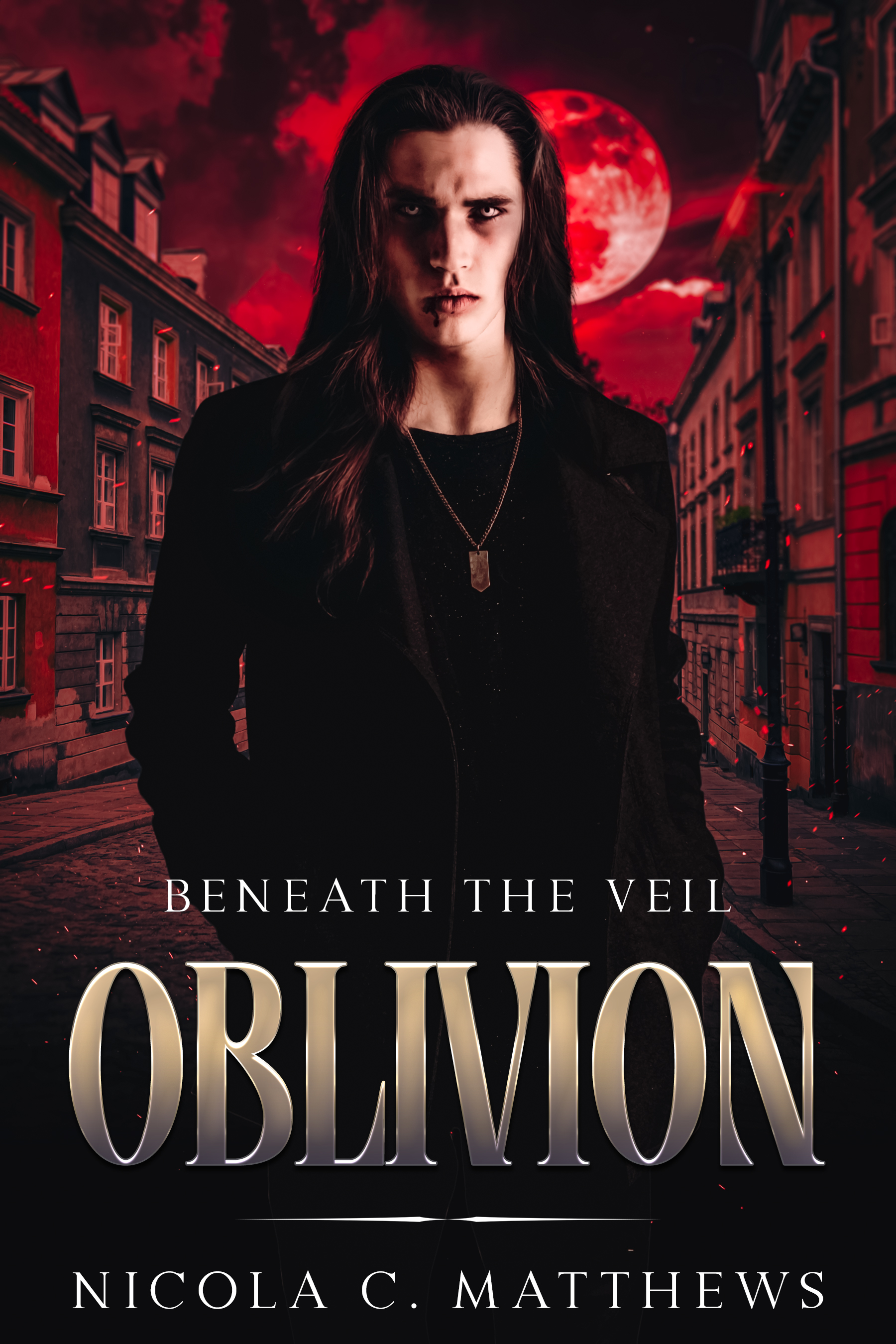
Cover Reveal: Oblivion, Book 1

The long wait is over! Oblivion, Beneath the Veil Book 1, will be available October 31st. Preorder links will be posted to all social media as soon as they become available. Now, for the moment everyone has waited for, it’s cover reveal time!

For over a century, the mysterious Shield of Humanity has stood defunct, it’s crimes against the paranormal kindred world all but a distance memory. But in the realm of vampire nobility, someone is targeting members of the royal families. The vicious slayings send shockwaves through the community, and it has The High Council on edge. Needing answers, they dispatch their elite detectives, the vampire Stealth and his shapeshifting metahuman partner, Annaleigh Shade, to unravel the dark mystery surrounding the murders.

Following a gruesome trail of dismembered bodies from the shadowy alleyways of Louisiana to the dusty roads of Texas, they are desperate to apprehend the relentless killer before another royal falls prey. 

But everything is not what it seems. Their cunning foe always seems to be one step ahead. With every step, the duo uncovers a web of lies, vendettas, and conspiracies. Can Stealth and Annaleigh uncover the malevolent force responsible for the grisly slayings? Or will more royals fall victim before they uncover the truth?

Behind every shadow lurks sinister secrets. The stakes have never been higher as the bloodthirsty assassin taunts The High Council, leaving death and destruction in its wake. The bodies are piling up, and the clock is ticking in this thrilling paranormal mystery.